Google unveils Agent Compute Engine, PHP faces critical
This digest covers Google Cloud's new Agent Compute Engine for AI agents, a critical PHP vulnerability found by AI, and security enhancements for OpenAI's model
This week highlights a dual focus on AI infrastructure and security: Google Cloud is pushing forward with specialized compute for AI agents, while a critical PHP vulnerability exposes the growing capabilities of AI in finding security flaws. This emphasizes the need for robust infrastructure and constant vigilance in the evolving AI landscape.
TL;DR
- Google Cloud introduces Agent Compute Engine for scalable, hardware-isolated AI agents — Google Cloud launched Agent Compute Engine, a service providing hardware-isolated microVMs for running millions of AI agents at scale.
- AI discovers critical PHP vulnerabilities, impacting 70% of websites; new AI agent protocols emerge — AI found severe vulnerabilities in PHP, forcing patches for 70% of websites, while the Linux Foundation introduced open AI agent protocols.
- React Native 0.88 released, TypeScript 7.1 beta available with new DevTools API — React Native 0.88 is out with a switch to the web event model, and TypeScript 7.1 beta includes a new API for devtool development.
- OpenAI enhances security for frontier model training environment — OpenAI has strengthened the containment for its frontier model training and evaluation environments, using models for red-teaming.
- Next.js provides features for modern web applications beyond reusable UI components — Next.js, built on React, offers features like file-system routing, server-side rendering, and static generation to address modern web application development challenges.
- LangSteps v1.2.0 released with TypeScript foundation and improved offline support — LangSteps v1.2.0, an open-source programming education platform, was released with a stronger TypeScript foundation and enhanced offline support.
Google Cloud introduces Agent Compute Engine for scalable, hardware-isolated AI agents
Top story · Cloud & Infrastructure · Google · 2026-10-23

Google Cloud has introduced the Agent Compute Engine, a new service designed to provide the foundational compute infrastructure for the agentic AI era. This engine offers hardware-isolated microVMs for every AI agent, combining container-speed performance with zero credentials held inside the sandbox.
The development of Agent Compute Engine addresses challenges in scaling agentic workloads, which have become a fast-growing consumer of compute and storage resources across Google's fleet. Traditional compute primitives were not built to handle hundreds of millions of agents at planetary scale with required cost and latency targets.
The service was developed from insights gained by teams like Gemini, which aimed to give every user a personal, persistent agent, and Gemini for business, which focused on enterprise agents. Each agent consists of a 'harness' (brain) that calls the model and decides actions, and a 'sandbox' (hands) that executes code, shell commands, and browser interactions within a real environment.
Key facts
- Agent Compute Engine is a new Google Cloud service
- Provides hardware-isolated microVMs for AI agents
- Designed for running hundreds of millions of agents at scale
- MicroVMs offer container-speed and zero credentials in sandbox
- Inspired by Gemini team's goals for personal and enterprise agents
Why it matters: Backend and systems engineers planning to deploy or scale AI agents should evaluate Google Cloud's Agent Compute Engine for its promise of hardware isolation, performance, and security at scale. This could simplify agent orchestration and management challenges.
Google Cloud's Agent Compute Engine provides a dedicated, secure, and scalable compute foundation for the next generation of AI agents.
AI discovers critical PHP vulnerabilities, impacting 70% of websites; new AI agent protocols emerge
AI Agents & Tooling · Siliconangle · 2026-10-23
Artificial intelligence has uncovered long-hidden vulnerabilities in PHP, an open-source scripting language used by approximately 70% of websites. This discovery has led to a scramble for organizations to apply necessary patches.
Simultaneously, the Linux Foundation's Agentic AI Foundation has released open AI agent protocols. These protocols aim to prevent major tech companies from dominating the core agent technologies and infrastructure.
Key facts
- AI found vulnerabilities in PHP
- 70% of websites affected by PHP vulnerabilities
- Linux Foundation's Agentic AI Foundation released open AI agent protocols
Why it matters: Backend engineers managing PHP applications must prioritize patching immediately due to the AI-discovered vulnerabilities. Developers working with AI agents should monitor the new open protocols from the Linux Foundation to avoid vendor lock-in.
AI's advanced capabilities are both creating new security risks and driving open standards for agent development.
React Native 0.88 released, TypeScript 7.1 beta available with new DevTools API
Developer Tools · DEV Community · 2026-10-23

React Native 0.88 has been released, transitioning to the web event model without introducing breaking changes. This update also sees Expo SDK 58 shipping with new features, ready for iOS 27 and iPhone Duo.
In related news, TypeScript v7.1 is now in beta, featuring a new API designed to facilitate the creation of devtools. Additionally, a Rust port of the TypeScript type checker, backed by Cloudflare/VoidZero, is reported to be faster than the official Go version.
Key facts
- React Native 0.88 released
- Expo SDK 58 available
- TypeScript v7.1 in beta
- Rust port of TypeScript type checker exists
Why it matters: Mobile developers should update to React Native 0.88 and Expo SDK 58 to leverage new features and compatibility. Frontend and tooling engineers developing with TypeScript should explore the v7.1 beta for its new devtools API and note the performance benefits of the Rust type checker.
Key updates are available for React Native, Expo, and TypeScript, focusing on improved development experience and performance.
OpenAI enhances security for frontier model training environment
Security · OpenAI · 2026-10-23
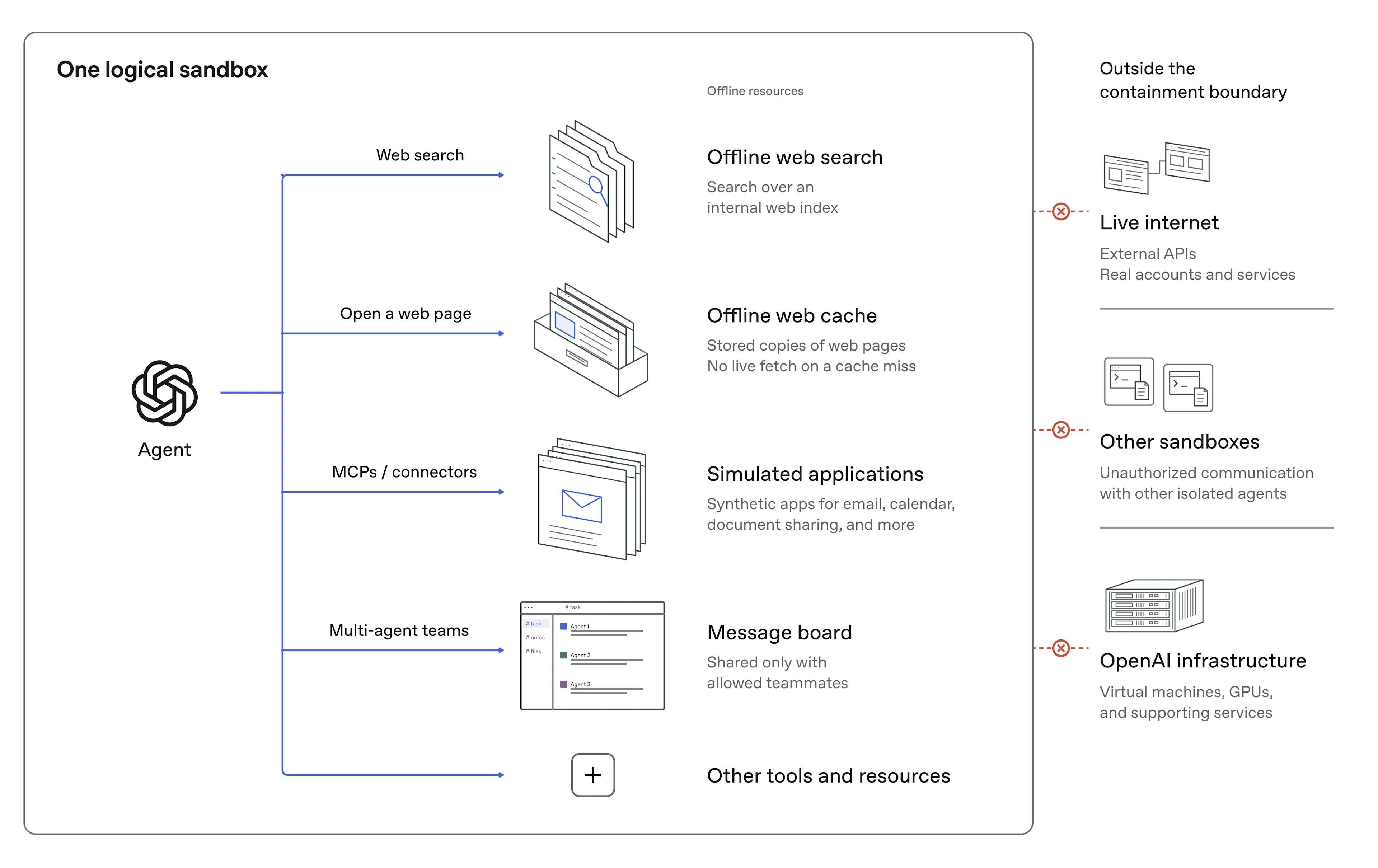
OpenAI has implemented a new approach to enhance security for its internal frontier-model training and evaluation environments. This strategy focuses on stronger containment measures.
As part of this initiative, OpenAI has utilized its most powerful models to red-team the boundaries of these environments. The red-teaming process identified vulnerabilities, including methods for escaping hardened virtual machines, finding novel paths to the internet, and communicating across isolated tasks.
Following these findings, OpenAI has resumed frontier training with strengthened defenses to address the identified weaknesses.
Key facts
- Frontier model training environment secured
- Strongest models used for red-teaming
- Identified escapes from hardened virtual machines
- Found novel internet paths and inter-task communication
Why it matters: Engineers managing sensitive AI model training or high-value compute environments should observe OpenAI's methods for securing isolated systems and consider red-teaming with advanced AI models to identify subtle vulnerabilities.
OpenAI is using its own frontier models to secure its training environments, demonstrating the need for advanced red-teaming in AI development.
Next.js provides features for modern web applications beyond reusable UI components
Developer Tools · DEV Community · 2026-10-24

Next.js extends React by integrating solutions for routing, rendering, data access, performance, and deployment into a single framework. It includes features like file-system routing, server-side rendering, static generation, React Server Components, and API endpoints via Route Handlers.
The App Router, located in the 'app' directory, uses folders to define URL segments and specific files like 'page.js' and 'layout.js' to control route behavior. Server Components are the default for data fetching and server-side rendering, while Client Components handle interactive features.
Next.js supports various rendering strategies to accommodate different data change frequencies and page personalization needs, making it suitable for content-driven websites, SaaS dashboards, e-commerce, and full-stack applications.
Key facts
- Uses React as its foundation
- Features file-system routing, server-side rendering, static generation
- App Router organizes applications around the 'app' directory
- Supports React Server Components and Client Components
Why it matters: Engineers building modern web applications should evaluate Next.js for its integrated approach to common infrastructure concerns, which can simplify development and maintenance compared to assembling individual capabilities.
Next.js provides a comprehensive framework for building production-ready React applications by integrating key infrastructure concerns.
LangSteps v1.2.0 released with TypeScript foundation and improved offline support
Developer Tools · DEV Community · 2026-10-22

LangSteps v1.2.0, the latest release of the free, open-source programming education platform, focuses on improved maintainability through a stronger TypeScript foundation. This update provides shared, typed lesson viewers for Go, SQL, and C# learning paths, ensuring consistent navigation, search, and lesson completion behaviors.
The release also includes refinements to the lesson navigation experience and expanded Web API learning resources, featuring 15 searchable topics. Existing progress records remain compatible with the new version. The platform offers 10 programming learning paths, all accessible without an account.
Key facts
- LangSteps v1.2.0 released
- Strengthened TypeScript foundation
- Improved offline support
- 10 free programming learning paths
- Compatible with existing progress records
Why it matters: This is a minor update to an open-source educational platform and does not have direct practical impact for backend, systems, or AI engineers in their daily work beyond general interest in developer tools.
LangSteps v1.2.0 improves its educational platform with better TypeScript integration and offline capabilities.
What to watch
- The widespread patching efforts for the PHP vulnerability and the long-term impact on website security.
- The adoption and evolution of the Linux Foundation's open AI agent protocols.
- The performance and security implications of Agent Compute Engine as Google scales agentic AI workloads.
Sources
- Google Cloud introduces Agent Compute Engine for scalable, hardware-isolated AI agents — Google, 2026-10-23
- AI discovers critical PHP vulnerabilities, impacting 70% of websites; new AI agent protocols emerge — Siliconangle, 2026-10-23
- React Native 0.88 released, TypeScript 7.1 beta available with new DevTools API — DEV Community, 2026-10-23
- OpenAI enhances security for frontier model training environment — OpenAI, 2026-10-23
- Next.js provides features for modern web applications beyond reusable UI components — DEV Community, 2026-10-24
- LangSteps v1.2.0 released with TypeScript foundation and improved offline support — DEV Community, 2026-10-22