Amazon acquires Decart for AI optimization; Anthropic IPOs at
Amazon acquires Decart's AI optimization software for $7.5 billion ahead of Trainium chip sales. Anthropic completes largest IPO in history with $1.5 trillion
Today's news highlights a tension between rapid AI advancement and calls for its controlled development. While Amazon invests in AI optimization for its chips and Anthropic achieves a record-setting IPO, OpenAI proposes a metric to pace future AI progress.
TL;DR
- Amazon acquires Decart's AI optimization tech for $7.5 billion, boosting Trainium chips — Amazon has acquired Israeli startup Decart's AI optimization software stack, DOS, and its team for $7.5 billion, aiming to enhance the efficiency of AI models on its Trainium chips.
- Anthropic achieves $1.5 trillion valuation in record-breaking $81.3 billion IPO — Anthropic raised $81.3 billion in the largest IPO in history, reaching a fully diluted valuation of about $1.5 trillion, a significant return for early investors.
- OpenAI's chief scientist proposes perplexity as a metric to limit AI development speed — OpenAI's chief scientist Jakub Pachocki suggests using perplexity as a standard measurement to set limits on the speed of AI development.
- Asus ProArt P16 laptop with Nvidia RTX Spark offers local AI capabilities for $7,000 — The new Asus ProArt P16 laptop, priced up to $7,000, features the Nvidia RTX Spark chip and up to 128GB of memory to run local AI agents and models.
Amazon acquires Decart's AI optimization tech for $7.5 billion, boosting Trainium chips
Top story · AI Agents & Tooling · TechCrunch · 2026-11-23

Amazon has purchased a significant portion of Decart, an Israeli startup, for $7.5 billion. Decart is known for its Decart Optimization Stack (DOS) software, which improves the efficiency of AI models on various hardware, including Nvidia, Amazon, and Google's chips. The deal includes Decart's technology, founding team, and AI researchers and engineers.
Amazon's SVP Peter DeSantis stated that more efficient compute leads to better training, reinforcement learning, faster inference, and better models at lower costs. Amazon plans to start selling its Trainium chips to customers, and Decart’s technology is expected to help customers run workloads more easily on Trainium, competing with Nvidia.
Key facts
- Acquired for $7.5 billion
- Decart Optimization Stack (DOS)
- Acquires Decart's founding team and AI researchers/engineers
- Amazon's Trainium chips
Why it matters: Engineers working with AI models will need to evaluate how Decart's optimization stack integrates with Amazon's Trainium chips, potentially offering new avenues for cost-effective and efficient model deployment as an alternative to Nvidia hardware.
Amazon's acquisition of Decart aims to make its Trainium chips a more competitive and efficient option for AI model deployment.
Anthropic achieves $1.5 trillion valuation in record-breaking $81.3 billion IPO
Industry · TechCrunch · 2026-11-23

Anthropic, the maker of Claude, completed an $81.3 billion IPO, which is described as the largest in history. This resulted in a fully diluted valuation of approximately $1.5 trillion before its shares began trading.
Investors like Notable Capital, GIC, and Baillie Gifford made substantial investments in Anthropic through various funding rounds. Notable Capital's investment in Series E was based on increasing developer preference for Claude, which they found was used 70% of the time, reversing trends from the previous year. GIC invested over $4.5 billion across Series F, Series G, and a pre-IPO round, noting strong enterprise adoption driven by model improvements like Claude Code. Baillie Gifford invested after observing Anthropic's consistent execution, strong revenue, and compelling gross margins.
Key facts
- Raised $81.3 billion in IPO
- Fully diluted valuation of about $1.5 trillion
- Developers favored Claude 70% of the time
- GIC invested over $4.5 billion
Why it matters: While primarily a financial event, Anthropic's valuation and investor confidence suggest continued growth and investment in large language models, indicating stability and ongoing innovation in the AI model space for engineers to leverage.
Anthropic's massive IPO valuation underscores strong investor confidence in large language models and their commercial adoption.
OpenAI's chief scientist proposes perplexity as a metric to limit AI development speed
AI Models · TechCrunch · 2026-11-23

Jakub Pachocki, OpenAI's chief scientist, has proposed using 'perplexity' as a metric to limit the speed of AI development. This idea comes amidst discussions on controlling AI progress due to potential catastrophic risks, as highlighted by a former OpenAI/Anthropic researcher and Anthropic's IPO filing.
Pachocki argues that while 'downstream capability' benchmarks quickly become outdated, perplexity – which measures how well a model predicts the next token – remains 'informative'. He notes that lower perplexity values correlate with the emergence of transformative AI capabilities, such as those seen in cybersecurity and mathematics when perplexity fell below 0.8. The proposal suggests using perplexity to establish 'common limits' on AI progress until understanding and monitoring of AI behavior reach specific milestones.
Key facts
- Perplexity measures how well a model predicts the next token
- GPT-4 had a perplexity of ~0.91
- Transformative capabilities emerged below 0.8 perplexity
- Proposal for 'common limits' on AI progress
Why it matters: If adopted, perplexity as a control metric could directly influence the pace of new AI model releases and capabilities, requiring engineers to adapt to potentially slower development cycles or regulated access to frontier models.
Perplexity is proposed by OpenAI as a technical metric to establish a shared benchmark for AI progress and potentially set limits on development.
Asus ProArt P16 laptop with Nvidia RTX Spark offers local AI capabilities for $7,000
Developer Tools · Ars Technica · 2026-11-23
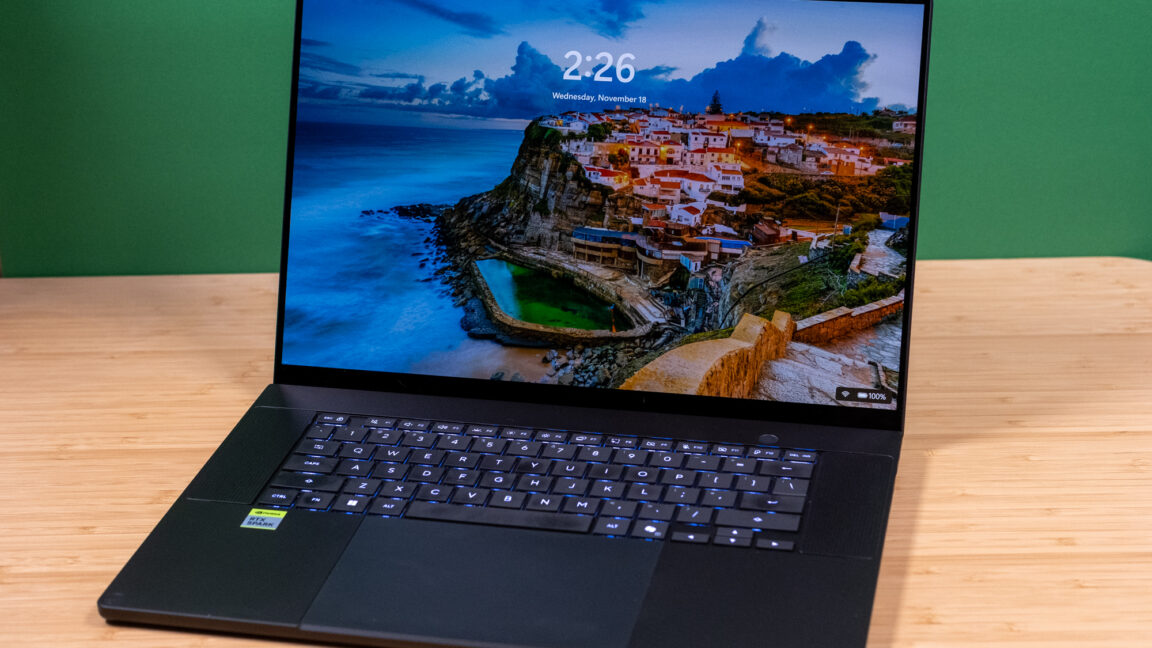
The Asus ProArt P16 laptop integrates Nvidia's new RTX Spark chip, providing significant memory (up to 128GB LPDDR5x unified memory) to support local AI models and agents. The top-end configuration costs $7,000. The laptop is designed as a unified machine for AI, productivity, and gaming.
The Spark N1X chip includes a 20-core Grace CPU (10 Arm Cortex-X925 cores and 10 Arm Cortex-A725 cores) and a Nvidia GB20B Blackwell GPU with 6,144 cores, offering up to 31 TFLOPS of FP32 graphical performance and around 1,000 TOPS of FP4 AI compute. While enabling local AI, the review notes that local AI still requires trial and error.
Key facts
- Up to $7,000 price point
- Nvidia RTX Spark N1X chip
- Up to 128GB LPDDR5x unified memory
- 1,000 TOPS of FP4 AI compute
Why it matters: For developers and researchers building local AI agents or requiring substantial on-device AI compute, this hardware could be a powerful platform, though its high price and nascent local AI tooling mean it's an early adopter device.
The Asus ProArt P16 is a high-spec, high-cost laptop designed for running local AI agents on Nvidia's new RTX Spark platform.
What to watch
- How Amazon's integration of Decart's DOS will impact the competitive landscape for AI hardware and model optimization, particularly against Nvidia.
- The ongoing debate and potential for industry-wide adoption of perplexity or other metrics to regulate AI development speed and its implications for access to frontier models.
- Further developments in local AI hardware and software, and whether devices like the Asus ProArt P16 become more accessible and user-friendly for running a 'small army of agents'.
Sources
- Amazon acquires Decart's AI optimization tech for $7.5 billion, boosting Trainium chips — TechCrunch, 2026-11-23
- Anthropic achieves $1.5 trillion valuation in record-breaking $81.3 billion IPO — TechCrunch, 2026-11-23
- OpenAI's chief scientist proposes perplexity as a metric to limit AI development speed — TechCrunch, 2026-11-23
- Asus ProArt P16 laptop with Nvidia RTX Spark offers local AI capabilities for $7,000 — Ars Technica, 2026-11-23